
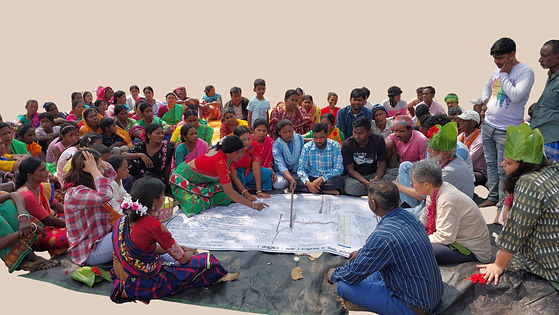
Community expressions on CBNRM


Community members shared their knowledge and plans for the Community-based Natural Resource Management (CBNRM) Plan
MAKE PEOPLE RESILIENT & THRIVING
Join us in improving community-driven development for marginalised communities

Project Sashaktikaran
The Sashaktikaran project, meaning 'empowerment,' is funded by the Paul Hamlyn Foundation in the UK and is taking place in the Mohammed Bazar Block of Birbhum District, with a completion target of 2029. More than 25,000 tribal individuals are involved in community-driven development (CDD) through micro-plans that address GPDP, enhance local governance, and promote effective resource management. This initiative aims to ensure Adivasi communities own the natural resources, development initiatives, and Panchayat funds. To support this ownership, CSRA focuses on enhancing the community's knowledge and capabilities for independent project analysis, planning, and execution in collaboration with panchayats and government entities. The project includes three key components: Strengthening Local Governance, Water Resources Management, and promoting climate-resilient agriculture.

Project Stone Workers' Empowerment
CSRA is working to secure rights for over 12,000 workers in the Ballast Stone Quarry and Crushing units across 65 Birbhum District villages, with support from the Azim Premji Foundation. The organisation raises awareness among stone workers about their workplace rights and has partnered with the government health department for early detection and compensation for silicosis-affected workers. It also aims to connect employees to social security benefits and foster the establishment of workers' collectives. CSRA is committed to boosting awareness of stone workers’ rights and encouraging dialogue with employers and stakeholders on wages and working conditions through legal means. Additionally, it collaborates with the Government Health System to ensure timely identification, certification, and compensation for silicosis sufferers, in line with the state’s Silicosis Relief, Rehabilitation and Treatment Policy.

Project Land Rights & Climate Resilient Agriculture
CSRA is addressing land ownership within the Santhal tribe, with a particular focus on women in 30 Santhal villages in the Birbhum District, West Bengal. This initiative is supported by the Indigenous Peoples' Assistance Facility (IPAF) through the International Fund for Agricultural Development (IFAD) for a period of 3 years. The Tebtebba Foundation of the Philippines is providing knowledge and monitoring support for this project. The primary aim of the project is to foster stakeholder engagement, enhance capacity building, document processes, and facilitate collaboration among women and youth to assert their rightful claims for better land governance. With the assistance of land experts, the organisation offers training to community youth and women, in collaboration with local self-government (Panchayat) authorities, on tribal and women’s land rights. This includes organising community-led participatory sessions for the application, mapping, verification, and recording of rights (ROR) related to land. CSRA is also promoting climate-resilient agricultural practices and encouraging agroecological farming among farmers, women, and youth.

Project Micro Solar Irrigation &
Drinking Water
CSRA has implemented the SOLAR project with support from EKOenergy's Climate Fund to help 850 small and marginal farmers in seven tribal villages located in the rain-fed and drought-prone upland areas of Birbhum District, West Bengal, India. The initiative targeted food insecurity and climate change impacts by improving irrigation through the installation of advanced solar pump systems, with the aim of cultivating over 325 acres of farmland and enabling a transition to double cropping. Community participation, particularly from women, is central to the project, ensuring local involvement in managing irrigation infrastructure. Furthermore, CSRA promotes a community-led irrigation strategy and has developed water management and groundwater recharge techniques in partnership with local governments. Training, demonstrations, and exposure visits are vital components designed to foster effective adaptation practices supported by mobile-based weather updates and crop planning services.

Past Initiatives
Project SOLAR

The SOLAR project was funded by the German Embassy of Kolkata and planned with the community to address the issues of food production, farm income, adversities of climate change, as well as subsistence farming through augmenting irrigation facilities with small-lift irrigation systems. The project was intrinsically focused on harnessing irrigation facilities for two villages with 149 numbers of deprived tribal households through deep excavation irrigation systems. The project facilitated a unique approach, that of “community-led solar irrigation”, which has brought water directly to the fields and met their drinking water needs too. The project has also fostered community ownership from the onset of project conception, to survey and implementation, right through to operations and maintenance.